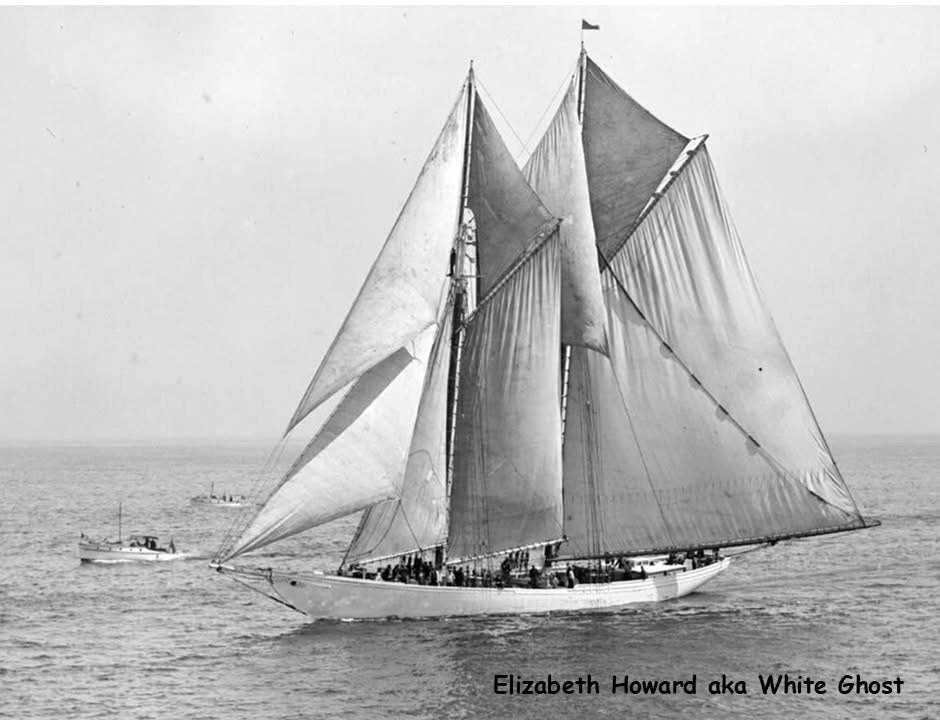
William W. Howard – A Friend of Rose Blanche In early January of 1921 the sister schooners “Elizabeth Howard” and “Louise Howard” limped into Rose Blanche with sails torn, bulwarks smashed and small boats carried away. The ships were enroute to Curling, Bay of Islands from the Turk’s Island loaded with salt for the herring fishery. They encountered storms in the Atlantic and were nearly three weeks overdue. Being late in the season, and fearing they may be frozen in at the Bay of Islands, the vessels put in at Rose Blanche. Their owner, William Willard Howard of New York City was at Curling and made his way to Rose Blanche. What he witnessed there would shape his life for the next few years. Here’s what he wrote: “When I went on board I found on the schooner’s decks groups of men from shore, who were waiting in mute misery for such scraps of food as the cooks might happen to pass out from the galleys. Some of the men said that for three days they had had nothing but fish heads to eat.” “On shore I was horrified to find a condition of poverty, destitution, sickness and suffering almost beyond belief. Sickness due to undernourishment was in every house; families had eaten nothing but fish heads for days; outlying communities had had nothing to eat except dry bread for two weeks; men, driven desperate by the hunger of wives and children, had looted a local merchant’s warehouse in broad daylight without arrest or restraint. The fishermen had plenty of salt codfish on hand but owing to the regulations and restrictions of the Newfoundland government, which was trying to control the price of salt fish in Europe in spite of the laws of supply and demand, they were unable to sell it. They were starving in the midst of an abundance of a food which, taken by itself, will not sustain human life.” Codfish Exportation Act Seven months earlier in May of 1920 the Codfish Exportation Act was introduced by Sir William Coaker to protect fishermen from being exploited by wealthy St. John’s merchants and to stop exporters from undercutting each other in foreign markets. Strict minimum export prices were established for salt cod. The regulations granted an exclusive marketing monopoly to a British firm for trade with Italy, one of Newfoundland’s major markets. Independent merchants and local traders along the south coast were completely blocked from negotiating their own sales in Italy. Europe was plunging into a post war recession and when Italy’s economy faltered, the south coast suffered heavily. They were also dealing with export duties to Unites States and a shortage of salt for the upcoming winter fishery. Providence Some locals considered it providence when William Howard and his ships arrived at Rose Blanche during their difficult time. He was deeply touched by the state of affairs writing: “There was only one thing that I could do. My two ships were filled to the deck beams with fishery salt consigned to another part of Newfoundland but I instructed the captains to sell their cargoes to the merchants of Rose Blanche and to use the proceeds in the purchase of fish from destitute fishermen. I returned to the United States in advance of my ships and offered the fish for sale to the wholesale fish trade all along the Atlantic coast, from New York to Bucksport. I could not get so much as one offer, although salt codfish was selling in the retail grocery stores for 35¢ a pound. The warehouses of the wholesale fish merchants were filled with stocks of high-cost fish, which were being worked off on consigners at wartime prices.” “The outlook was blue. I had two vessels on the way to the United States with soft-cured codfish that nobody wanted. I decided to sell the fish direct to consumers. I packed the fish in neat wooden boxes holding 100 pounds each, and offered to make deliveries at any railroad station east of the Mississippi River at $10 per box, freight prepaid. The price was too low. Consumers who were paying 35¢ for salt codfish could not believe that I could sell equally good fish for 10¢. As a matter of fact, my Newfoundland fish were better than the salt codfish in the stores because it never had been treated with whitening chemicals or preservatives. The price of $10 did not allow any margin for shrinkage, nor for postage, printing and clerical labor. But having offered the fish at $10 I filled all orders received.” After intense opposition from fish merchants and exporters the government realized their folly that January and began rolling back the restrictions on sales to Italy. There was still an export tax of 30¢ per quintal with the United States and other countries. The government claimed it was the exporter that paid the tax and not the fishermen. The fishermen begged to differ saying the Americans knew they where being charged 30¢ per quintal so they paid them that much less for their fish. Rose Blanche, known as the “Gloucester of Newfoundland” was in despair and the failure of R. Moulton Limited and other firms along the shore, were all attributed to Coaker’s Fish Regulations. On May 3, 1921 the Codfish Exportation Act officially ended when it was repealed by the House of Assembly. Second Campaign William Howard suspended operations during the summer of 1921 but said he was continuing to receive appeals for help from Newfoundland. He wrote, “In the autumn I began again with fresh supplies of fish. In December, I sent one of my vessels to Newfoundland to buy a cargo of herring. I carried the sale of codfish through from November until the beginning of warm weather in June, when I suspended operations for the summer. During this second campaign I sold the fish at $12 per box, freight collect. This price enabled me to come through without actual loss. In the event that it may be necessary for me to help the fishermen of Newfoundland in this way again, the price will be not less than $13.50, freight collect, for the reason that the new tariff adopted by Congress places an import duty of 1 ½¢ a pound on salt fish. I cannot ask the fishermen of Newfoundland to accept 1 ½¢ a pound less for their fish.” “Dr. Grenfell heard of my work and came to see me at my office at 70 Fifth Avenue, New York. Since that time he has shown a keen and sympathetic interest in this form of practical relief. I have suggested to Dr. Grenfell that his Association take over the work that I have begun and carry it on as a permanent measure of relief for destitute fishermen along the coasts of Labrador and Newfoundland, and also as a source of income. I am certain that thousands of customers could be obtained through the supporters of the Grenfell Association.” William Howard There’s not a lot known about William Willard Howard of New York. He had the “Elizabeth Howard” built in 1916 quickly followed by her sister ship “Louise Howard” in 1917. The “Louise Howard’s” time was short. Just two months after leaving Rose Blanche, she went aground in a gale off Beaufort Bar, NC with nearly a ton of dynamite on board. The crew of 10 men were taken off by the Coast Guard before the vessel became a total loss. The “Elizabeth Howard”, built for speed, was nicknamed the “White Ghost”. She competed against the top racers during her time. In March of 1923 she was caught in a blizzard near Sable Island when a great sea struck, sweeping four of her nine crew on deck overboard to their deaths. The following morning she encountered the vessel “Helen M. Coolen”, battered and sinking from the storm, after losing two men. Sixteen of her survivors rowed their dories through heavy seas to the safety of the “Elizabeth Howard” as their vessel sank. Eight months later The “Elizabeth Howard” aka “White Ghost” was wrecked off Porter’s Island, Nova Scotia and was a total loss. All eight members of the crew survived. Photos are in the comments. If you are viewing from a share, you may need to click on the feature photo to view comments and photos. These Dates in History – October 16th to Oct 20th Two Local Men Break World Record On October 16, 1944 the RCMP Patrol Schooner “St. Roch” arrived in Vancouver after a record setting 86 day first ever single season voyage through the Northwest Passage. Frank Mathews (28) and Stan McKenzie (26) of Port aux Basques were members of the crew. The “St. Roch” had made this voyage in 1940, the first vessel to make the voyage but it took two years. Matthews and McKenzie must have been concerned that this would be their fate. They also had to be concerned with German submarines. Matthews was determined to get the job done. There was no way he was spending the winter trapped in arctic ice. Unknown to the Skipper, Matthews would open the “St. Roch” to full throttle each time he was at the helm. These two Port aux Basques seamen contributed immensely to historical event. Kevin Parsons & Max Crewe On October 16, 1977 junior hockey had returned to Port aux Basques with the formation of the Jr. Centennials. While the executive were busy attempting to raise money, player Kevin Parsons took the initiative of bicycling 477 km from Grand Falls to Port aux Basques to do his part raising funds in support of the team. Kevin’s ride inspired Max Crewe to make the bike ride from Grand Falls the following summer to raise funds for the Port aux Basques Hockey Association. October 17th Nil October 18th Worst Ever Seen On October 18, 1895 an intense storm raged from the Gulf with hurricane force wind causing much destruction among the fishermen of Codroy. Stages, flakes and wharves were demolished while boats were driven ashore on the island from their moorings and badly damaged. The harbour was all one mess of white foam. Some of the old fellows said it was the worst ever seen. It was fortunate none were out in their boats. Several men from Codroy, who fished out of the Highlands, were also deprived of all they had trust to. Their boats, summer dwelling houses, gear and nearly all their summer’s catch of fish were all washed away into the sea. The following morning, some people, near the seaside at Codroy, could go from house to house in small boats. Tragedy at Rose Blanche On October 18, 1898 a Fortune Bay schooner ran ashore at Rose Blanche during a storm while a tremendous sea was raging. Two dories were sent from the ship with lines to attach to the shore. One of the dories was swamped and two men were lost. Men from Rose Blanche went in search of them the next day and the body of Jacob Thornhill (17) was found entangled in the line from the schooner. The body of the second young man, also named Thornhill wasn’t recovered. Solomon Rees & John Hulan On October 18, 1899 Solomon Rees of Channel accompanied by a young man named Keeping went duck-shooting to a salt water pond a few miles west from the settlement of Grand Bay. Knowing that taking cover was more favorable for a shot than remaining in the open, Rees and Keeping separated, each hid in a clump of bushes, both being out of sight of each other. From his position Solomon perceived an object which he took to be a bird on the water, and after satisfying himself that it was so, took aim and fired. Upon going to pick up his bird he was horrified to find the body of a young man shot through the head and cold in death. He most likely recognized the lifeless body of 17-year-old John Hynes of Grand Bay. Mr. Rees was frantic over his mishap, and had to be assisted to Channel by Keeping, where he immediately reported to the authorities. The police constable and doctor left at once for the scene of the accident. The constable was perplexed to discover that nearly a dozen men were around the pond hidden for the same purpose of duck-shooting, and neither party knew of the other’s presence until after the accident. The magisterial enquiry showed that the victim had assumed a sitting position, while lying in wait for game near the pond shore, and that his head just projected above the bushes in front of which he was waiting, his body thus being concealed from the view of any person further back. This gave his head the appearance of a bird on the water from the position in which Solomon Rees was situated, and the twilight added to and increased the deception, and that consequently the shooting was purely accidental. Solomon was devastated but he had a bigger battle to fight. The young school teacher was soon to become ill with tuberculous. Sadly, he passed away on New Year’s Day in 1902 at age 31. George Lewis Pike On October 18, 1901 the community of Channel loss one of its most promising young men. George Lewis Pike was drowned at sea by falling from aloft from the schooner “New Dominion”. George was a young man of excellent character and qualifications who gave promise of attaining a master’s position. October 19th Nathan LeMoine On October 19, 1924 the schooner “Una” was towed into port reporting the loss of her captain, Nathan LeMoine (49), of Burgeo. All hands were working on deck at night in rain when a cry of help came from the captain. An attempt was made to launch a boat but by the time everything was in readiness, the vessel had proceeded so far from where Nathan had gone overboard that it was useless to make further effort. Endeavouring to reach St. John’s the vessel was driven 50 miles out to sea where the mainsail was lost. The main boom also broke off and the jib was torn in shreds. The crew of three men had a difficult time working the “Una” back to land with the remaining canvas. She reached Freshwater Bay five days after the captain was lost. The crew members were the captain’s son, Benjamin Cox of Burnt Islands and Thomas Strickland of parts unknown. Schooner A. Hubley On October 19, 1930 the schooner “A. Hubley”, Theordore Keeping of Channel owner and master, was in ballast bound from Isle aux Morts to Channel when she ran ashore and filled with water. The crew landed safely but the schooner was expected to be a total loss. George Brenton & Gordon Walters On October 19, 1940 HMCS Bras d’Or disappeared in the St. Lawrence River. The vessel’s orders were to shadow the Romanian freighter “Inginer N. Vlassopol” to ensure she made way to Sydney, NS. When the “Bras d’Or” departed Rimouski, QC, she grounded on a shoal only minutes outside of port. She managed to free herself and continued shadowing the Romanian freighter. Both ships encountered poor weather. At 0350 the first officer of the Vlassopol reported the lights of the Bras d’Or suddenly vanished. It is believed that she had sustained unnoticed hull damage at Rimouski and that it combined with stormy conditions led to her demise. George Breton (23) & Gordon Walters (22) from Port aux Basques were lost in the tragedy. Con Artist Sent to Prison On October 19, 1951 the Magistrate’s Court at Channel was busy. A man with the last name Barry had called on several merchants leaving an impression that he was a travelling salesman who could sell them goods far below the going price. He was able to obtain quite a sum of money from some of the merchants and then escaped town unnoticed. The RCMP kept on his trail, eventually arresting him at Corner Brook. He was brought back to Channel for trial. The magistrate sentenced him to 18 months in prison. October 20th Thomas Downey On October 20, 1937 Thomas Downey (87) of Grand Codroy passed away. Thomas was an old hero whose exploits 50 years earlier rescued two shipwrecked men from raging seas. At the time of the wreck at Net Cove, he went out into the raging surf and rescued a man. He went back the second time and pulled another man safely to shore. On his third attempt he cast a line and lassoed the captain’s arm. The captain, seeing his wife in imminent danger beyond, slipped off the rope and swam to her assistance. Thomas cast off the rope again and just as it was again passed over the captain’s arm, he and his wife were crushed to death among the floating wreckage. With seas raging, Thomas went beyond the safety of his rope and brought their remains to the shore. Additional information on Thomas Downey is found in the story “The Downey’s – Pioneers of the Codroy Valley” at the following link: https://www.facebook.com/share/p/1DNtxGFX6i/ Duncan MacIsaac On October 20, 1942 Duncan MacIsaac of the Codroy Valley passed away suddenly at age 75. Duncan carried on an extensive business in the Valley and was a household name on the west coast. During his life he devoted his energies in developing the agricultural resources of the area. The farm products and cattle raised in the Valley were known throughout the island due to the persistent work of this pioneer. October Windstorm On October 20, 1975 a wind storm caused viewing from a share, you may need to click on the feature photo to view comments and photos. The next post “The Plaindealer” is scheduled for Oc