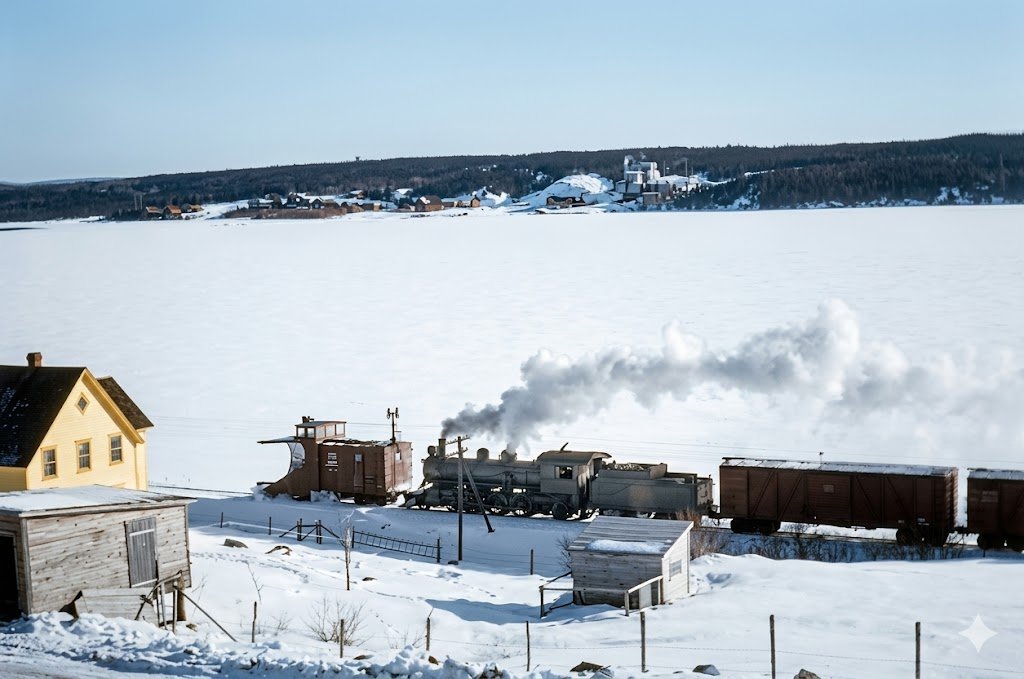
The Last Steam Train on the Bonavista Branch
Some pictures are more than pictures.
Some hang on a kitchen wall for years before you fully understand what they are.
This picture hung on the wall in my parents’ kitchen for many, many years. I saw it plenty of times growing up, but I didn’t really understand the significance of it until a few years ago.
At first, it was just an old train picture.
Snow on the ground.
Smoke in the cold air.
Houses and sheds sitting quiet around the track.
But when you know the place, and when you know the story, it becomes something else.
This was Shoal Harbour, in an area once known as Mills Siding.
And that old steam train was making history as it passed through.
If you are a Ryan, Mills, or Benson, there is a good chance this scene means something to you. Many people from those families could have stood in their own front yard and watched this old train go by.
The garage in the picture was Stewart Mills’s old garage.
The house belonged to Jack Mills’s family.
To some people, that might just be background.
But around here, background is never just background.
A house tells you who lived there.
A shed tells you who worked there.
A track tells you where the world used to pass through.
This was the last steam train to run down the Bonavista Branch.
The date was March 14, 1957.
Train No. 12.
Engine No. 593.
The Bonavista Branch stretched about 88 miles from Shoal Harbour to Bonavista. For years, it connected places, people, freight, families, and memories along the line.
After that final steam run, the branch would move on with diesel locomotives. But this picture caught the end of something older.
Not just machinery.
Not just iron and wheels.
A whole sound.
A whole feeling.
A part of Newfoundland life passing by in smoke and snow.
And the man in the engine was Monroe Greening.
Anyone my age who grew up around Clarenville and Shoal Harbour knew Monroe Greening.
That is what makes this story feel even closer.
This wasn’t some faraway railway name in a book.
This was a man people knew.
A man connected to the place.
A man who brought that steam engine down the Bonavista Branch and back up toward Clarenville.
The story goes that Monroe was supposed to take her on to Bishop’s Falls.
But as he was heading back toward Clarenville, knowing what was waiting for that engine, the weight of it hit him.
She wasn’t just another engine anymore.
She was the last of her kind on that branch.
A working piece of Newfoundland railway life coming to the end of the line.
And Monroe Greening started to cry.
He refused to take her on to Bishop’s Falls.
Not because he couldn’t do the job.
Because he knew exactly what the job meant.
So the engine sat on the siding in Shoal Harbour until another engineer came out from Bishop’s Falls the next day to take her on her final run.
That part of the story stays with a person.
Because it turns the train from iron into memory.
It shows that even machines can carry a kind of heart when enough people have worked with them, listened to them, depended on them, and watched them pass through their lives.
A train can be steel.
A branch line can be track.
But when people remember it, it becomes part of home.
That is what this picture holds.
It holds Shoal Harbour.
It holds Mills Siding.
It holds the old Bonavista Branch.
It holds families who watched from their yards.
It holds a kitchen wall where the picture stayed for many years.
And it holds a man who could not bring himself to carry that old engine to her ending.
That is not just railway history.
That is Newfoundland memory.
The kind that sits quiet for years until one day you look again and realize what was there all along.
A picture on the wall.
A plume of smoke over snow.
A steam engine passing through Shoal Harbour.
A branch line nearing the end of an era.
And a story that still has enough heart in it to make people stop and remember.
Not a lecture.
Not a history book.
Just a little spark from puffincove.